
Skip to tool
ecech.
🏠 Home & Construction

Mosaic Needs Nearly Three Times the Grout of Large Format

Grout fills joints, and small tiles have far more joint per square foot. The floor size is the least important input.

Grout needed


Bags to buy


Type required


Joint per sq ft

linear feet of joint

The same floor, different tile

The formula

Advertisement

How the calculation works

The same 132 sq ft floor, four tile sizes 24 x 48 12.3 lb 12 x 24 37.0 lb 12 x 12 98.8 lb 4 x 4 mosaic 98.8 lb Bars are 5 px per pound. Identical floor, 8 times the grout from one end to the other.

How to Use This Tool

Enter the tile dimensions, the joint width and the tile thickness. The floor area only scales the answer; the tile size decides the rate.

Grout fills joints, and small tiles are mostly joint

A square foot of 24 x 48 porcelain contains very little joint. The same square foot of 4 x 4 mosaic is criss-crossed with it. Because grout volume follows the length of joint rather than the area of floor, the tile size is the dominant input and the floor size is the least interesting one.

lb per sq ft = ((A + B) / (A x B)) x C x D x 47.9

132 sq ft floor:

24 x 48, 1/16 joint, 1/2 thick   0.094 lb/sq ft   12.3 lb
12 x 24, 1/8  joint, 3/8 thick   0.281            37.0 lb
12 x 12, 1/4  joint, 3/8 thick   0.748            98.8 lb
 4 x  4, 1/8  joint, 1/4 thick   0.748            98.8 lb

mosaic against large format                       8.0x
The floor never changed

Joint width and tile thickness both multiply

Both appear linearly in the formula, so doubling either doubles the grout. A thicker tile at the same joint width needs proportionally more because the joint is deeper, which is the part people forget when switching from a 1/4 in wall tile to a 1/2 in floor tile at the same spacing.

Sanded and unsanded are not interchangeable

Below about 1/8 in the joint is too narrow for sand to pack into, so unsanded grout is used. Above that, unsanded shrinks and cracks as it cures, so sanded is required. Choosing by preference rather than by joint width is a common and expensive mistake, and this tool flags which one the joint demands.

The exception runs the other way too: sand can scratch polished marble and some glass, so those surfaces need either a narrow joint with unsanded grout or a specialist product.

Buy more than the calculation

Ten per cent is the usual allowance, and it covers more than spillage. Grout has a working time, so a batch that stiffens has to be discarded rather than retempered with water, and mixing a second small batch from a nearly empty bag risks a colour difference across the floor. As with tile, the whole job should come from the same lot.

What is not counted here

Thinset mortar under the tile is a separate calculation driven by trowel notch size rather than joint width. Sealer, caulk for movement joints and the corner joints that should be silicone rather than grout are all separate too.
Advertisement

Frequently Asked Questions

How much grout do I need?
It depends far more on the tile than the floor. A 132 sq ft floor needs about 37 lb in 12 x 24 tile with 1/8 in joints, but 98.8 lb in 12 x 12 with 1/4 in joints — the same floor, nearly three times the grout.
What is the grout coverage formula?
Pounds per square foot equals ((A + B) divided by (A times B)) times joint width times tile thickness times 47.9, with all dimensions in inches. Tile size and joint width both drive it linearly.
Do small tiles use more grout?
Considerably. Small tiles have much more joint length per square foot, so 4 x 4 mosaic can need eight times what 24 x 48 large-format porcelain needs on an identical floor.
Sanded or unsanded grout?
Unsanded below about 1/8 in, sanded above it. Unsanded in a wide joint shrinks and cracks as it cures; sanded will not pack into a narrow one. It is set by the joint width rather than by preference.
Does tile thickness change the grout needed?
Yes, linearly. The joint is as deep as the tile, so a 1/2 in floor tile needs twice the grout of a 1/4 in wall tile at the same joint width. This is the input most calculators leave out.
How much extra grout should I buy?
About ten per cent. Grout has a working time, so a batch that stiffens is discarded rather than retempered, and mixing a late batch from a different bag risks a visible colour difference across the floor.

Related tools in Home & Construction

Browse all Home & Construction tools
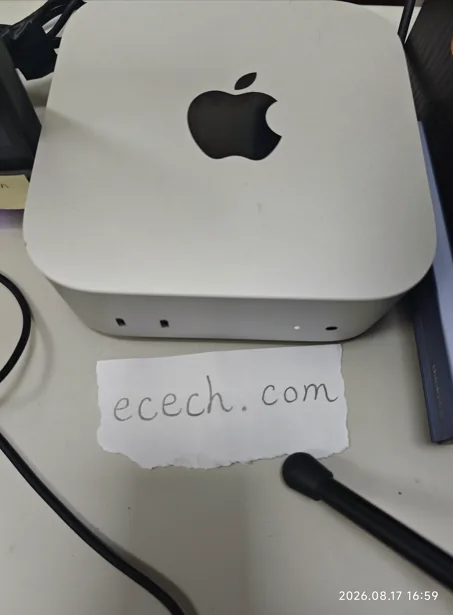
The Mac mini the ecech. site is built on, beside a handwritten note reading ecech.com.

Made by one person

ecech. is not a content farm. Every tool here is written and checked by hand, one at a time, by someone who wanted the tool to exist and could not find a version that showed its working.

No accounts and no sign-in, and nothing you type reaches a server — every calculation on this page runs inside your browser. The ads are served by Google and do set their own cookies, which is set out in full on the privacy page. More about the site.