
Skip to tool
ecech.
💻 Developer & Code

SHA-256 and Friends, With a Note on Why This Is Not Encryption

Hashing is one-way with no key, so nothing can be decrypted from it. Useful for checking a file arrived intact — and the wrong tool for storing passwords.

Hashes

Advertisement

How the calculation works

One character different, nothing in common "hello" 2cf24dba5fb0a30e… "hellp" fdd7585e08c4e2af… One letter changed. Every digit of the output changed, and there is no way to tell from the hashes that the inputs were nearly identical. That is what makes a hash a good integrity check, and useless for hiding anything.

How to Use This Tool

Type text or drop a file. All four hashes are computed at once, and if you paste a published checksum it is compared for you.

A hash is not encryption

Encryption is reversible with a key. Hashing is one-way and has no key: a hash of a gigabyte and a hash of one letter are both 64 hex characters, so most of the input has been thrown away. There is nothing to decrypt, and any site offering to "decrypt" a hash is either looking it up in a table of precomputed common inputs or lying.

What a hash is good for is integrity. If a file's SHA-256 matches the one the publisher printed, the bytes you have are the bytes they released. Change one bit and the hash changes completely.

Do not store passwords like this

This is the most consequential misuse. SHA-256 is designed to be fast, and that is exactly wrong for passwords: modern hardware computes billions of SHA-256 hashes per second, so a stolen table of unsalted hashes falls to a dictionary attack in a very short time.

Password hashing wants the opposite property. bcrypt, scrypt and Argon2 are deliberately slow and memory-hungry, with a tunable cost, and they salt each password so identical passwords produce different hashes. Use a library that implements one of them; do not build this from SHA-256 and a salt yourself.

Speed is a feature until it is the problem SHA-256 billions per second on a GPU — excellent for checksums, disastrous for password storage bcrypt / Argon2 deliberately slow and memory-hungry, with a tunable cost and a per-password salt Same operation, opposite design goals. Picking the wrong one is not a small error.
A checksum wants to be instant; a password hash wants to be expensive.

MD5 and SHA-1 are broken

Both are shown because you still meet them, and both are broken for security. Researchers can construct two different files with the same MD5 hash cheaply, and the same has been demonstrated for SHA-1. That means neither can prove a file is the one you expected against a determined adversary.

They remain fine as non-adversarial checks — detecting a corrupted download, deduplicating files, cache keys — where nobody is trying to trick you. If a publisher only offers MD5, it still catches transmission errors; it just does not prove authenticity. Note that MD5 is not available here, because browsers deliberately do not implement it.

Checking a download

  1. Get the checksum from the publisher's own site, over HTTPS — not from the same place as the file if that place could be compromised.
  2. Drop the file here and compare. This page never uploads it, so a large or private file is fine.
  3. A mismatch means the file is not what was published. That is usually a corrupted or interrupted download, and occasionally something worse.

A caveat worth stating: if an attacker can replace the file, they can often replace the checksum printed next to it. A checksum from the same compromised page proves little. Signatures — GPG, or a platform's own code signing — are what actually establish authenticity, because they involve a key the attacker does not have.
Advertisement

Frequently Asked Questions

Can a SHA-256 hash be decrypted?
No. Hashing is one-way and has no key — most of the input is discarded, since a hash of a gigabyte and of one letter are the same length. Sites offering to decrypt a hash are looking it up in a table of precomputed common inputs, which works only for short or predictable values.
Is hashing the same as encryption?
No. Encryption is reversible with a key and is for keeping things secret. Hashing is one-way and is for proving things have not changed. A hash does not hide data — if the input is guessable, computing hashes of guesses will find it.
Should I use SHA-256 to store passwords?
No. SHA-256 is fast by design, and modern hardware computes billions per second, so stolen unsalted hashes fall to dictionary attacks quickly. Password storage needs a deliberately slow, salted algorithm — bcrypt, scrypt or Argon2 — via an established library rather than something built by hand.
Is MD5 still safe to use?
Not for anything security-related. Two different files with the same MD5 can be constructed cheaply, and the same has been demonstrated for SHA-1, so neither proves a file is what you expected against a real adversary. Both remain fine for detecting accidental corruption or deduplicating files.
How do I verify a downloaded file?
Get the checksum from the publisher's own site over HTTPS, then hash your copy and compare. A mismatch means the file differs from what was published, usually because the download was corrupted. Note that if an attacker can replace the file they can often replace the checksum beside it — signatures, not checksums, establish authenticity.
Does my file get uploaded?
No. Hashing uses the browser's built-in SubtleCrypto and the file is read locally, which is why large or confidential files are safe to check here.
Why is MD5 missing from the list?
Because browsers deliberately do not implement it in their crypto APIs, on the grounds that it is broken and should not be made convenient. The SHA family shown here is what the browser provides natively.

Related tools in Developer & Code

Browse all Developer & Code tools
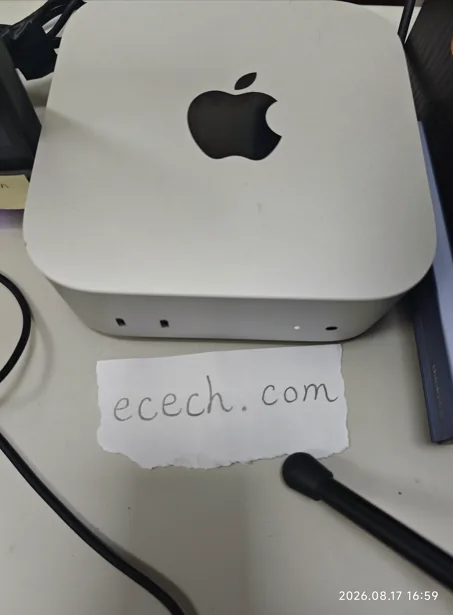
The Mac mini the ecech. site is built on, beside a handwritten note reading ecech.com.

Made by one person

ecech. is not a content farm. Every tool here is written and checked by hand, one at a time, by someone who wanted the tool to exist and could not find a version that showed its working.

No accounts and no sign-in, and nothing you type reaches a server — every calculation on this page runs inside your browser. The ads are served by Google and do set their own cookies, which is set out in full on the privacy page. More about the site.